Husky sledding in Tromsø: the complete guide
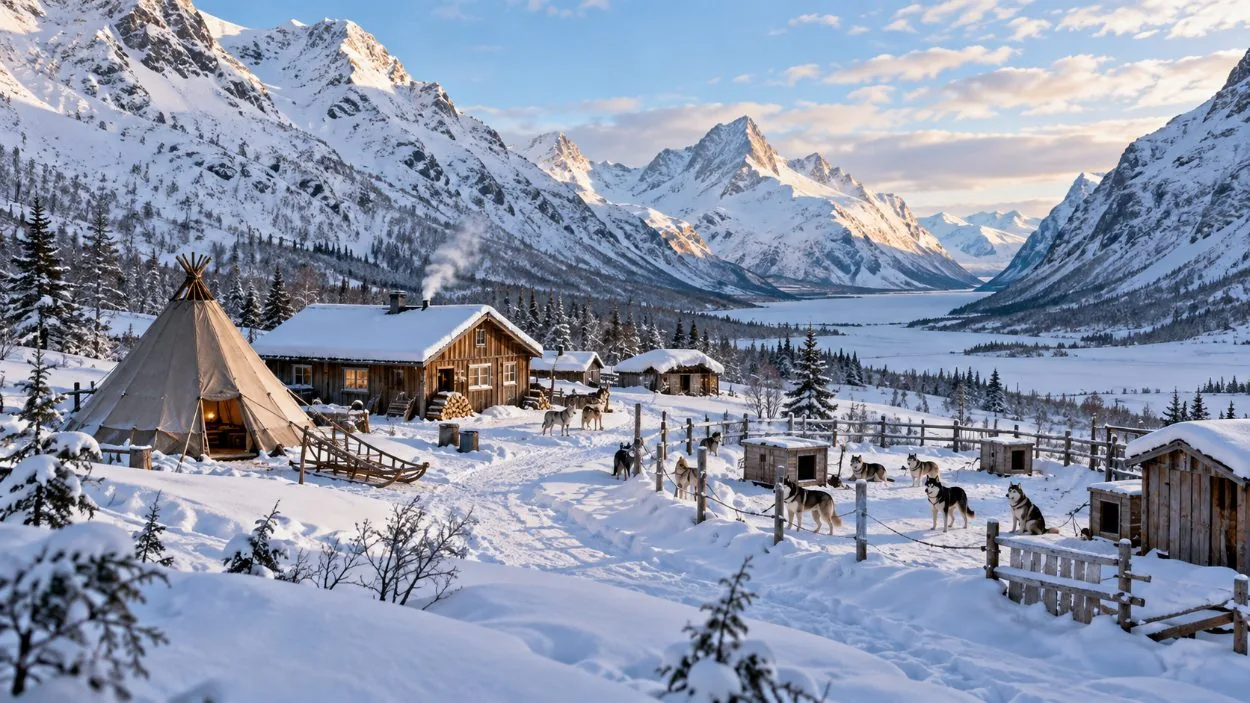
Husky tours run from Tromsø between November and April, and the one you book is really a choice of valley and a choice of clock. Camps sit between 25 and 95 minutes from town; the further inland you go the colder the air and the more reliable the snow, and the longer the day gets. On every one of them you are on the runners for 30 to 90 minutes of a four- to ten-hour trip. The rest is transfer, gear, briefing, the dog yard and a meal by a fire.
I spent eight winters handling dogs for kennels in Breivikeidet and the Tamok valley: harnessing teams, zipping guests into thermal suits, driving the bus, scooping the yard. The same forty questions came up at the bus door every winter, and this is me answering them once, properly.
Here is what nobody tells you before you book. In Tromsø you are not really choosing between six tours. The sledding is broadly the same wherever you go. What you are choosing is a valley and a clock.
The valley decides your snow
Tromsø sits 350 km inside the Arctic Circle and is absurdly mild for it. The North Atlantic Drift and the westerlies keep the January mean around −3.3 °C, and the city’s record low is roughly what Florida has managed. Mild coast means unreliable snow. Average depth peaks near 41 cm in January and is down to 26 cm by March, and midwinter thaws turn trails to ice more often than the brochures suggest.
Drive inland and the climate changes underneath you. Bardufoss, 70 km south, has a January mean of −9.7 °C and 93 days a winter at −10 °C or colder. Tamokdalen runs −10 to −20 °C, sometimes −30 °C, with little precipitation and little humidity. When operators call Tamokdalen the most snow-secure area near Tromsø they are stating a climate fact, not writing a slogan.
So the decision tree is short. A kennel on Kvaløya is 25 to 35 minutes away: the easiest logistics, the shortest day, the most weather risk in a thaw. Breivikeidet and Camp Aspemo sit around 50 to 60 minutes out, forest and fjord trails, the usual home of the big family products. Camp Tamok is 80 to 95 minutes, and you pay for that in bus time. Which is right depends on your month more than your taste; the three sit side by side here.
The clock has two hands
First hand: the day is mostly not sledding. You are on the runners for 30 to 90 minutes. The tour is 4 to 10 hours. Everything else is the drive, the gear room, the briefing, the dog yard, food in a lávvu and the drive back. Anyone who books expecting four hours of mushing comes home disappointed, and saying so is the reason this site exists. If the ratio matters to you, work it out before you pay.
Second hand: the sun does not rise in Tromsø between 28 November and 14 January. December averages 0.0 hours of sun above the horizon, January 1.8, February 7.4, March 11.9. A midday December tour runs in about five hours of blue twilight, roughly 09:00 to 14:00. It is genuinely beautiful, and not what most people picture when they book. March gives you a bright, photographable day and shakier snow near town, which pushes you inland, which closes the loop back to the valley. More on the light here.
What is honestly in the day
You meet at Tromsø Havn Prostneset or outside the Radisson Blu, and you get on a bus. At the camp you are issued a thermal suit and winter boots, usually mittens and a hat, over whatever you brought. Bring wool: cotton holds moisture, and moisture is what makes you cold. Then a briefing: how to stand, how to brake, how to hold the sled when the team stops. No licence is needed. Two of you share a sled and swap at the midpoint on the self-drive tours, so half of that 30 to 90 minutes is spent sitting in the basket. The dogs scream while they are harnessed and go quiet the moment the sled moves. Afterwards there is food and a fire, then the same road home in the dark.
The dogs, and the question you are actually asking
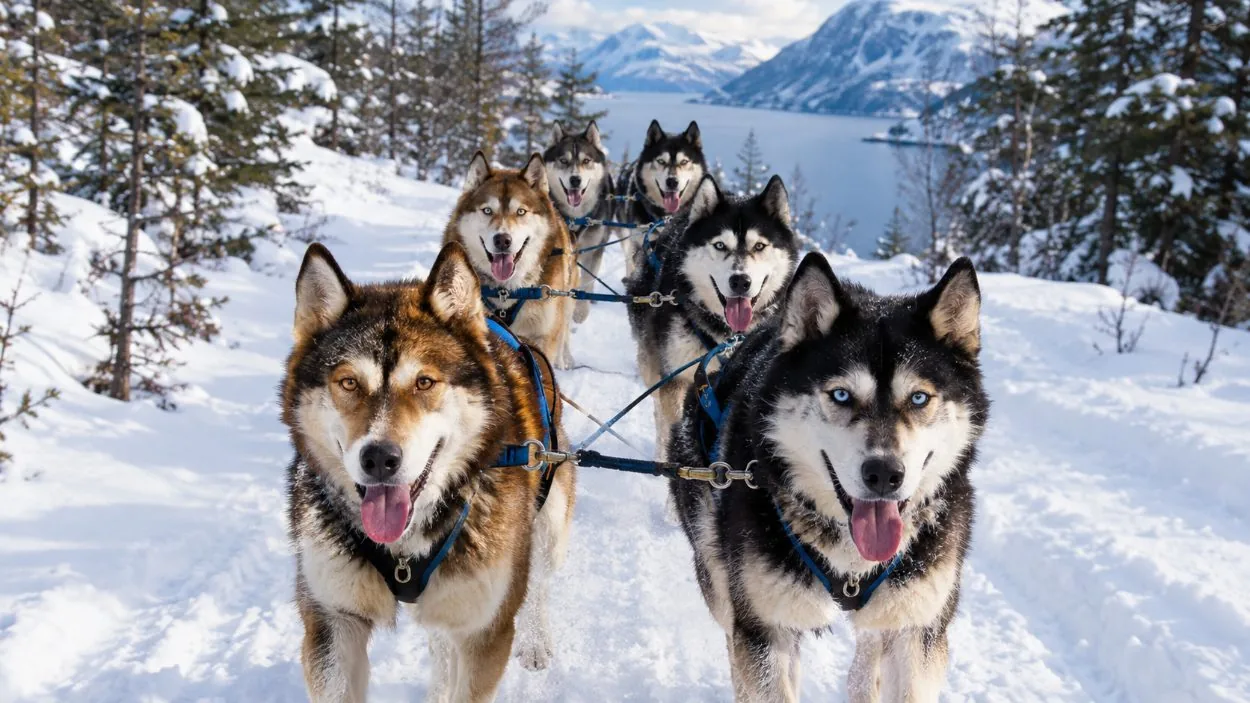
A tourist team is five to seven Alaskan huskies, arranged as lead, swing, team and wheel dogs, running at roughly 10 km/h. The Alaskan husky is not a recognised breed at all. It is a performance type crossed from Arctic village dogs, Siberian imports, pointers, shepherds and hounds, selected for pulling and appetite and weather tolerance, and it does its best work between −5 and −25 °C. Nobody publishes a kilometre figure for a standard run; operators sell time, not distance.
On welfare I will not sell you reassurance. Norway’s Animal Welfare Act applies, Mattilsynet inspects, and a 2017 risk assessment from Norway’s Scientific Committee for Food Safety found real risks of gastrointestinal problems, lameness and insufficient rest in long-distance racing dogs while noting the literature is thin. No Norwegian certification scheme for husky kennels exists, so no badge settles this for you. Check it yourself on the day: clean dry bedding and shelter, plentiful clean water in clean buckets, dogs that take an interest in you without flinching, group or free-run housing rather than permanent tethering. The cull people have read about happened at Whistler in Canada in 2010, not in Norway. The full set of checks is here.
Choosing between the six
Short trip, one free morning, want it done well: the 4.5-hour Breivikeidet tour, with more reviews than anything else here. Even tighter on time: the 4-hour self-drive with lunch, 25 minutes of driving, minimum age 16. Going in March, or want the cold and the mountains: the 7-hour Tamokdalen day. Fit, and after effort rather than scenery: the advanced tour at Camp Tamok, the only one rated below 4.8 and the only one where you push the sled uphill yourself. After the aurora as well: the 10-hour evening product, where lights are never guaranteed and what you are really buying is a dinner, a guided run and a snowmobile. Too young, too pregnant, too heavy or too unsure: the puppy kennel visit, which is a real answer and not second prize. All six, compared properly.
Ready to book?
If you have read this far and still want to go — and most people do — start with the tour that has the most reviews of any husky trip out of Tromsø, then check it against the other five and against which camp suits your week.
Frequently asked questions
Which husky tour should I book first?
If you want the shortest day, the tour that leaves for the Kvaløya kennels is back in town in four hours. If you want the most reliable snow, go inland to Tamokdalen and give up most of your day to it. The middle answer, and the most booked, is the Breivikeidet trip — see all six compared.
Do I need any experience to drive a sled?
No. Every self-drive tour teaches you on the spot, and no licence is required anywhere in Norway for a tourist sled. What operators do set is an age floor of 16 to drive, a weight limit, and a fitness expectation — you should be able to walk up three flights of stairs without getting out of breath. More in self-drive or guided.
Is it ethical to book a husky tour at all?
It is a fair question and it deserves more than a yes. Norway's Animal Welfare Act sets real duties, the Food Safety Authority inspects kennels, and a 2017 government risk assessment found genuine problems in long-distance racing. There is no Norwegian certification scheme to hide behind, so what is left is what you can see on the day — the checks are on this page.