The dogs: Alaskan huskies, team roles and what happens in summer
Alaskan, Siberian, malamute
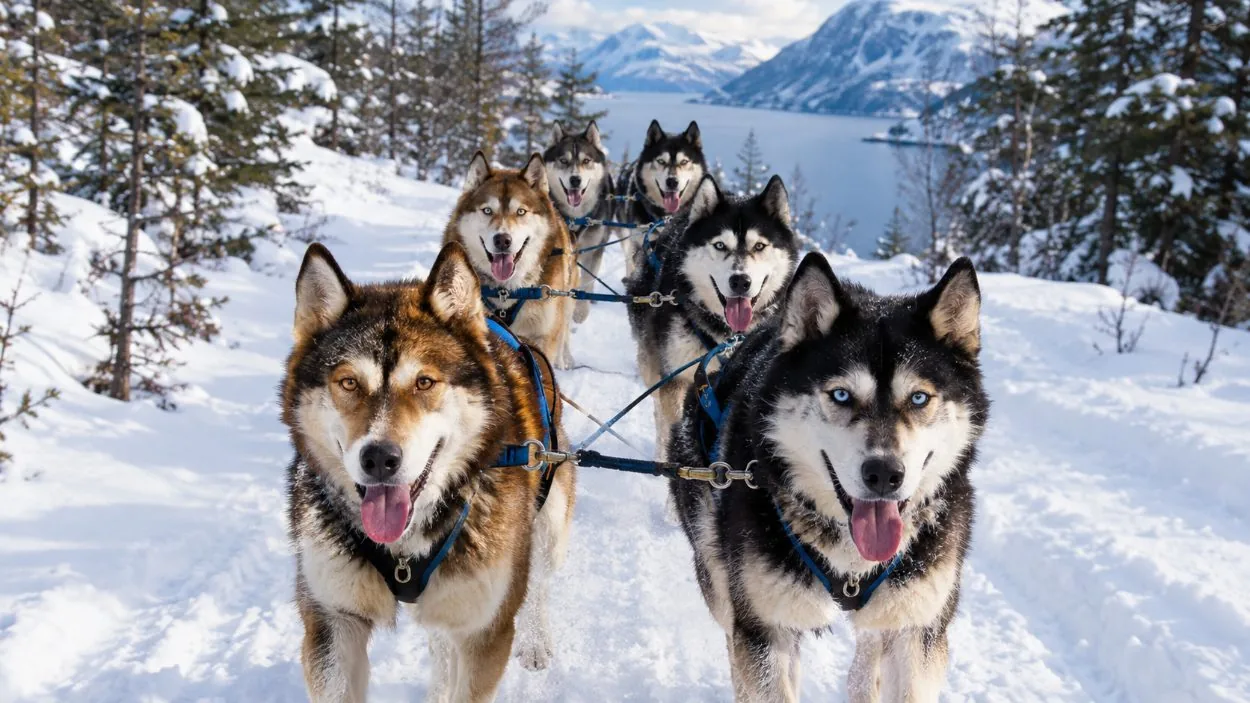
The Alaskan husky dominates Tromsø’s tour kennels and it is not a breed. There is no formal standard, no kennel club definition, nothing to conform to. It is a performance type bred from pre-Colonial North American Arctic village dogs and Siberian imports, crossed over the years with pointers, German shepherds, salukis, greyhounds and gundogs. Selection runs on pulling aptitude, endurance, speed, intelligence, appetite and tolerance of extreme weather. They weigh between 16 and 34 kg and they mostly look like nothing in particular.
Siberian huskies are the dogs on the postcards: the blue eyes, the mask, the thick coat. They are less commonly used commercially around Tromsø, so if that is what you came to meet, set your expectations before the yard rather than after it. Alaskan malamutes are different again, 36 to 54 kg, bred for freight strength rather than speed, and they turn up mostly on expedition-style trips.
Who stands where
A tourist team of 5 to 7 dogs is laid out in pairs by job. Lead dogs at the front take the commands and set the line. Swing dogs sit behind them and pull the team through turns. Team dogs in the middle add power. Wheel dogs, closest to the sled, take the hardest physical load because they are the ones swinging the sled out of corners. Handlers do not put dogs where it suits the photograph.
Speed on a tour is roughly 10 km/h, with 10 to 15 quoted across Nordic operators. Sprint teams of the same type can reach 45, and each dog can pull up to 40 kg. Dogs work best between −5 and −25 °C, which is another reason inland camps make sense in a mild coastal week.
Petting, names and the noise
Yes, you can normally touch them, and every product here includes yard time. Do not feed them — the kennel controls what these dogs eat and a guest with a snack is a genuine problem, not a charming one. Ask the handler for names. One kennel here keeps nearly 200 Alaskan huskies and runs 8 to 12 teams, and the handlers know all of them; I have never met a handler who did not want to talk about their leaders.
Expect noise before the run. A yard that sees harnesses come out goes off like a stadium and then falls silent the moment the teams move, which is the single most striking thing about the whole day. Detail on the rest of it at what to expect.
What they do in summer
They keep working, on wheels. When the snow goes, kennels switch to wheeled wagons and carts; one Tromsø wagon product runs from 1 August to 31 October out of a dog yard at Straumsbukta on Kvaløya, at Leirstandvegen 227. Those tours only run when temperatures are low enough to be safe for the dogs, which is a real constraint rather than a marketing line. The snowless season is covered at what happens if there is no snow.
Where these dogs come from, historically
Sled dogs were the main form of transport across the Arctic before planes and snowmobiles, and the racing tradition that shaped the modern Alaskan husky is still running. Finnmarksløpet, first held in 1981 with three teams, is the longest sled dog race in Europe, with classes from a 200 km junior race up to the FL-1200 across the Finnmarksvidda plateau to Kirkenes and back. The 1200 course was shortened to 1,107 km in 2025 because of warm weather. Roger Dahl finished his 28th Finnmarksløpet in 2025, at 73. My neighbour in Nordreisa ran it twice, which is how I ended up doing this for a living.
The welfare questions people most want to ask — what happens to a dog that stops running, how the yard is kept in October — are worth asking out loud at the kennel. What to look for is listed at is husky sledding ethical.
Spend a day with the dogs and no sled
Frequently asked questions
What kind of dogs pull sleds in Tromsø?
Almost always Alaskan huskies, which are a working type rather than a recognised breed, weighing 16 to 34 kg. Siberian huskies, the blue-eyed dogs most visitors picture, are less commonly used commercially. Malamutes are heavier freight dogs at 36 to 54 kg.
Can you pet the huskies on a Tromsø tour?
Normally yes, and every product here includes time in the dog yard. Feeding them is not allowed. The kennel day at husky kennel visits is built around dog contact rather than sledding.
What happens to the sled dogs in summer?
They run on wheels. Kennels switch to wagons and carts when the snow goes, and one Tromsø product runs 1 August to 31 October from a dog yard at Straumsbukta on Kvaløya. Those tours only operate when it is cold enough to be safe for the dogs.
How fast do the dogs run?
Roughly 10 km/h on a tourist run, with 10 to 15 km/h quoted across Nordic operators. Sprint teams of Alaskan huskies can reach 45 km/h. Each dog can pull up to 40 kg. More at how many dogs pull a sled.